
Perhaps one of the business world’s easiest arenas for running experiments is online advertising (e.g., pay-per-click search advertising). With the click of a button, you can easily vary one of many variables – messaging, keywords, budget, etc. – to instantly understand its effect.
Over the past couple of months, I’ve been collaborating with David on some different ways to optimize our online advertising efforts. The goal includes improving the downloading path/experience of new Firefox users, as well as understanding and optimizing the investment Mozilla is making in this channel.
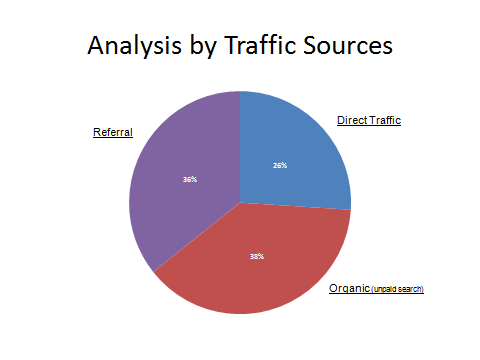
One upcoming experiment relates back to funnelcake. Some of you may remember that the source of downloaders looked this:

Thanks to the popularity of our download page and some recent search optimization efforts, the Firefox download page occupies the #1 organic search result in most major search engines (when searching for “Firefox”). With that in mind, one natural question that arises is: if we did zero pay-per-click (ppc) advertising, would our organic traffic (i.e., unpaid search) rise by a corresponding amount? In other words, given the following scenario:
- I am prospective Fx user
- I visit a major search engine searching for Firefox
- I have a propensity to click on paid ads
If I am not presented with an ad in the search results (an official Mozilla ad directing me to www.mozilla.com/firefox), will I instead click on the first organic search result (which also directs me to www.mozilla.com/firefox)?
So, from a results perspective, if we turn off our ppc advertising, we’ll be looking to see if the pie chart above morphs into the chart below (note the 38% organic picks up the 10% ppc from above). While the answer will likely be a strong “no,” we wouldn’t be responsible marketers without at least giving this question some thought and understanding how this dynamic impacts our true cost of acquiring a Fx user through online advertising.
We look forward to soon sharing our methodology and findings.
Matthew wrote on
:
wrote on
:
John Smith wrote on
:
wrote on
:
Andy Burns wrote on
:
wrote on
:
Pingback from Mozilla Online Advertising (Part 2) - Experiment Findings and Marginal Cost < Blog of Metrics on :
Pingback from Mozilla Online Advertising (Part 2) - Experiment Findings and Marginal Cost · Get Latest Mozilla Firefox Browsers on :
Pingback from Organic and Paid Search - How Opposites Interact | Giant Spatula > a Rolnitzky blog on :
Pingback from Organic and Paid Search - How Opposites Interact · Get Latest Mozilla Firefox Browsers on :
timfry wrote on
:
wrote on
:
Pingback from Another Mozilla Advertising Experiment - Bidding on Keywords < Blog of Metrics on :
Pingback from Another Mozilla Advertising Experiment - Bidding on Keywords · Get Latest Mozilla Firefox Browsers on :