Is Firefox Approaching 50% Market Share?
At least in one large region of the world, the answer is “yes”.
The folks at Gemius have been kind enough to aggregate their individual country data (e.g., www.en.ranking.pl/) into a single view across their entire sample – a sample totaling more than 60 Billion page views each month. For an overview of the various market share providers and their samples, please read here.
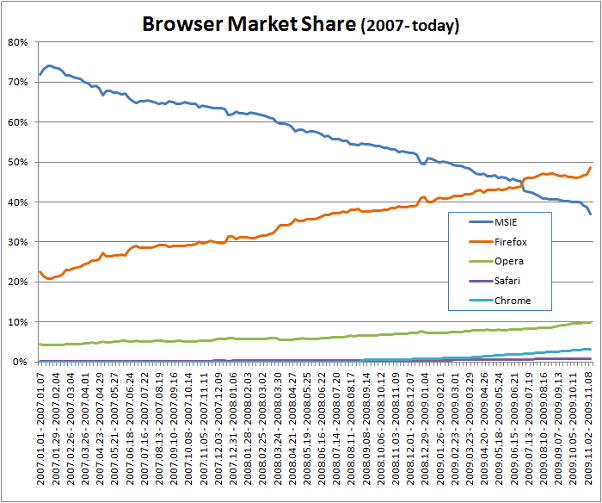
We’ll eventually look to expand the conversation around this data, but for now, we’ll highlight just one breathtaking view. The chart below shows weekly browser market share data since the beginning of 2007 and it includes aggregated data from across nine countries – Czech Republic, Bulgaria, Estonia, Hungary, Lithuania, Latvia, Poland, Russia, and Ukraine.
11 Comments to “Is Firefox Approaching 50% Market Share?”
Post comment
Recent Posts
- Why People Don’t Upgrade Their Browser – Part III
- Better Crash Trending – A Test Pilot Proposal
- People in France and Australia Are Also Switching Browsers
- People in Germany Are Switching Browsers
- Internet Usage in Haiti
- How Users Open New Empty Tabs
- The Long Tail of Firefox Use
- 40% Firefox Growth in 2009
- 55% of New Users Install Old Versions of Firefox
- Firefox’s Improving Stability
Archives
- January 2010
- December 2009
- November 2009
- October 2009
- September 2009
- August 2009
- July 2009
- June 2009
- May 2009
- April 2009
- March 2009
- February 2009
- January 2009
- December 2008
- November 2008
- October 2008
- September 2008
- August 2008
- July 2008
- June 2008
- May 2008
- April 2008
- March 2008
- February 2008
- January 2008
- December 2007
- November 2007
- October 2007
- September 2007

Ken Kovash


In another region of the world, Opera is approaching 50% (that includes Russia, which is *not* in the graph above since Gemius does *not* track it), or is, in fact, over 50% already.
http://my.opera.com/dstorey/blog/2009/03/16/a-look-at-desktop-market-share-cis-edition
Statistics are awesome, aren’t they?
It’s amazing (or maybe strange) how the drops and spikes in the MSIE and Firefox lines match perfectly. Though the MSIE line is dropping faster than the Firefox line is going up (i checked in Photoshop
).
Sounds like a rather random choice of countries.
Firfox is great,with lots of plugins and faster browsing.
w3schools.com graph looks similar:
http://imgur.com/ZzqM0.png
Congratulations on the continued growth. It would be interesting to see this broken down by operating system.
(BTW, you made a small typo: “We’ll eventually look to expand the conversation around this data” should be “We’ll write more about this later”.)
Firefox en IE grahpcs are just mirrored. Therefore this is just a fabricated image.
You should do your work Good Firefox, instead of giving us false information.
@Florent & Relief: Firefox and IE are the main players on that graph, thus *necessarily* they’re going to be largely mirrored. Think about it. The others are rather slow and steady and have no real spikes in them. If IE or Firefox spikes (for whatever reason) then the only place the numbers go to/from would be the other one. If IE went down, and the others didn’t move much, then Firefox went up, or vice versa. It’s a zero sum game here.
The graphs track (or “mirror”) each other because the total always has to add up to 100%. If one browser gains, it does so at the expense of the other browsers.
You can see similar patterns on a weekly scale as usage of older IE versions drops at the weekend and the drops are mirrored by rises in newer IE versions and Firefox etc.
Since all browsers are gaining over time except MSIE, then MSIE should be dropping equal to the aggregate rise of all the other browsers, not just firefox. So yes, this graph is BS.
@retry – InternetDestroyer ~IS~ dropping equal to the aggregate rise of the others. Read the graph. Add the numbers. You are the BS here.